How the CARES approach turns the brachos our children say every day into moments they truly feel.
The plate lands in front of a child, and before the fork is even lifted, a parent reminds, “Bracha first.”
The words come out in a single breath, so fast they blur together, eyes already on the potatoes.
We’ve all heard it. Many of us, if we’re honest, have said our own brachos the same way. The words are holy. We just weren’t really thinking about them.
This week, much of America sits down to a meal built around giving thanks, once a year. Jewish life, on the other hand, has woven gratitude in long before Thanksgiving existed, and not just once a year. It’s woven into every day, every bite, every sip, every new moment. Our children have countless opportunities to express gratitude before they even sit down to lunch. The question isn’t whether they have the words. The question is whether they feel what they’re saying.
A Hundred Moments a Day
Our Sages teach (Menachos 43b) that a person should say one hundred brachos every day. That’s a hundred times a day to stop, even briefly, and notice that something good has just been given to us.
Our expressions of gratitude begin even before we get out of bed, with Modeh Ani, ‘I thank You,’ said before we’ve done anything at all. Then come brachos for the body working as it should, for food, for drink. There are also blessings on viewing a beautiful sight, for a new fruit, and for reaching a new season of life.
This isn’t a holiday. It’s a way of living. In Jewish life, gratitude isn’t an occasional feeling we wait for. It’s a rhythm built into ordinary moments, so noticing the good becomes part of who we are.
The Talmud (Berachos 35a) puts it strikingly: enjoying something of this world without a bracha is like taking something holy and making it your own. Before the bracha, the Gemara says, the world is Hashem’s. After the bracha, it becomes ours. The bracha is how we recognize, “This was given to me.”
A bracha, in other words, is never empty words. It’s a pause that turns taking into receiving.
The Alter Rebbe adds a deeper layer in Torah Ohr (Mikeitz, maamar Roni V’simchi). He connects the word baruch to hamavrich, the Mishnah’s term for bending a grapevine branch into the soil so that it takes root and grows (Kilayim 7:1). A bracha draws Hashem’s blessing down from its hidden spiritual source into our world. Chassidus explains that a bracha does not create something new; it draws down what already exists at its source (Likkutei Sichos, vol. 29, p. 184). When we say a bracha with intention, even an ordinary bite becomes an opportunity to recognize Hashem’s presence and goodness in our lives.
Living the Brachos: CARES Begins With Us
This is where the CARES approach offers a unique path. CARES isn’t a technique for getting the right words out of a child. It’s a way of building relationships in which we, and our children, come to own the values we live by. And it begins with us. The brachos are a perfect place to see it in action.
Connect: Every day begins with connection. Before we stand up, before we check a phone or a schedule, we say Modeh Ani: “I thank You, living and eternal King, for You have mercifully returned my soul to me. Great is Your faithfulness.” Rabbah emunasecha.
The Rebbe taught that these words also remind us of Hashem’s great faith in us. Each morning, when Hashem returns our soul, we are given another opportunity to fulfill our unique purpose.
Our day doesn’t begin with a to-do list. It begins with a relationship, and with knowing that Someone believes in us. That is exactly what connection gives a child. Before we ask anything of them, they need to know we believe in them, too.
Affirm: Gratitude doesn’t deny what’s real. The Mishnah (Berachos 9:5) teaches that we are obligated to bless Hashem for the difficult just as we do for the good. Yet the Mishnah (Berachos 9:2) gives us different words for each. When we hear good news, we say Hatov Vehameitiv, acknowledging Hashem’s goodness. When we hear painful news, we say Baruch Dayan HaEmes, acknowledging Hashem as the true Judge. Both express faith, but each recognizes a different reality.
Being grateful doesn’t mean pretending everything is fine. Some days are hard. Some moments hurt. Affirmation means making room for that reality without losing sight of the good.
Our children need to experience this, too. When a child comes home disappointed, we don’t need to immediately point out everything they have to be grateful for. We can acknowledge their disappointment and help them see that a difficult experience doesn’t erase the good in their lives.
Gratitude can also be found in overcoming: the hard conversation that went better than we feared, the challenge we faced instead of avoiding, the day we simply got through. When we can be honest about what’s hard and still recognize what is good, our children learn that gratitude and struggle can live side by side.
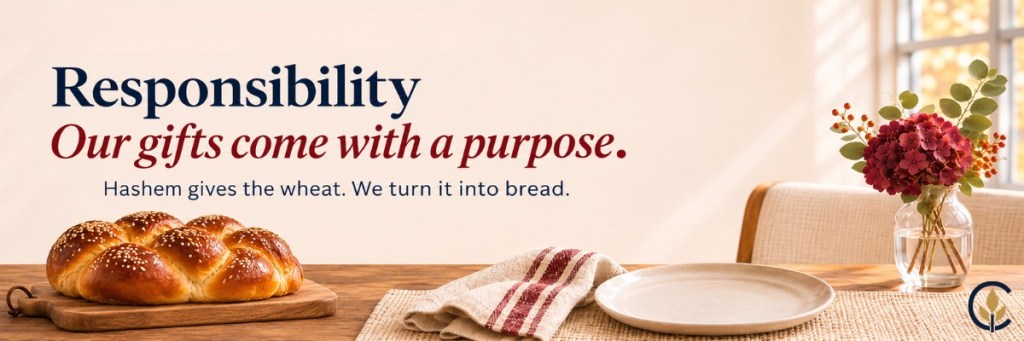
Responsibility: Our gifts come with a purpose. Hamotzi lechem min ha’aretz: “Who brings forth bread from the earth.” Rabbi Akiva illustrates the partnership between Hashem and man by presenting stalks of wheat alongside loaves of bread (Midrash Tanchuma, Tazria 5:1). Hashem provides the wheat, but we must turn it into bread.
Every gift we’re given carries a similar responsibility. Our talents, strengths, and abilities come from Hashem, but what we do with them is up to us. Gratitude begins with recognizing what we have been given and finds expression in how we choose to use it.
This is a tremendous understanding to give a child. A child talented in art can use that talent to bring a Torah story to life for others. A child who excels at sports can use that ability to encourage a struggling teammate. Even a child who naturally notices how others are feeling can use that sensitivity to make someone feel included.
As parents, we can help our children make this connection by asking not only, “What are you good at?” but also, “What can you do with what Hashem has given you?”
Responsibility, then, isn’t simply a burden we place on our children. It’s an invitation: you’ve been given something special, and the world needs what only you can do.
Empower: Noticing the effort, not just the outcome. Every morning we say Hanosen laya’ef koach, thanking Hashem for giving strength to the weary. The Alter Rebbe explains that each evening we entrust our weary soul to Hashem, and each morning Hashem returns it to us renewed (Shulchan Aruch HaRav 46:6). We express gratitude not only for what we have, but also for the strength we are given to keep going.
Our Sages teach, lefum tza’ara agra: “according to the effort is the reward” (Avos 5:23). Hashem values not only what we accomplish, but also the effort it takes to get there.
How often do our children recognize their own growth? They know when they get a good grade, win a game, or complete a project. But do they notice the patience they developed, the frustration they worked through, or the courage it took to try again?
As parents, we can help them see what they might otherwise overlook. “I noticed how you worked through that frustration.” “That used to be difficult for you. Look how far you’ve come.” “What helped you keep going when you felt like giving up?”
When we help our children recognize their own growth, we give them something beyond encouragement in the moment. We help them discover strengths they can draw upon the next time they face a challenge.
Gratitude, then, extends beyond what our children have received. It includes appreciating who they are becoming.

Sustain: Making gratitude a way of life. The Rambam explains that our Sages instituted brachos of praise, gratitude, and supplication kedei lizkor es haborei tamid — so that we should always remember our Creator (Hilchos Brachos 1:4). The goal is not simply to remember Hashem a hundred times a day, but to develop an awareness of Hashem that carries into the moments in between.
The same is true of the values we hope to instill in our children. One meaningful conversation about gratitude can make an impression, but what our children experience consistently shapes how they see the world.
When our children hear us express appreciation for an ordinary meal, notice another person’s kindness, or recognize Hashem’s hand in something that happened during our day, gratitude becomes part of our home’s culture. They see that gratitude is something we live by, not simply something we expect of them.
Ultimately, we want our children to notice the good even when no one points it out, to recognize Hashem’s hand even when no one reminds them, and to carry that awareness into the homes they will one day build themselves.
What We’re Really Hoping For
Tomorrow, when we place a plate of food in front of our child, we may still need to remind them, “Bracha first.”
But what happens in the moments between those reminders is what will ultimately give those words meaning.
When our children experience a home where gifts are recognized, difficulties are acknowledged, strengths are discovered, and blessings are put to purposeful use, the words of the bracha begin to reflect the life they are living. What we hope will remain is not simply the habit of blessing Hashem, but the awareness that there is something to bless Hashem for.
Gratitude isn’t a holiday or a polite phrase. It’s how a Jewish person begins every moment. Knowing the words of a bracha is knowledge. Seeing the world through those words is chinuch.
Want to keep growing with the CARES approach? Join our monthly newsletter to learn how to build relationships where children own the values we hope to live by. Sign up here.
Rabbi Avremi Popack works with schools, educators, and parents to build cultures of connection through the CARES approach. Learn more at Chinuch Impact.


Leave a Reply